Once a bit of distance has been created, our behavioural patterns can be understood through five conflict styles. These are defined by Kenneth W. Thomas and Ralph H. Kilmann in the Thomas‑Kilmann Conflict Model (TKI). The model categorises behaviour in conflict situations and helps us adapt our actions to what the situation requires – not by changing our personality, but by expanding our behavioural repertoire.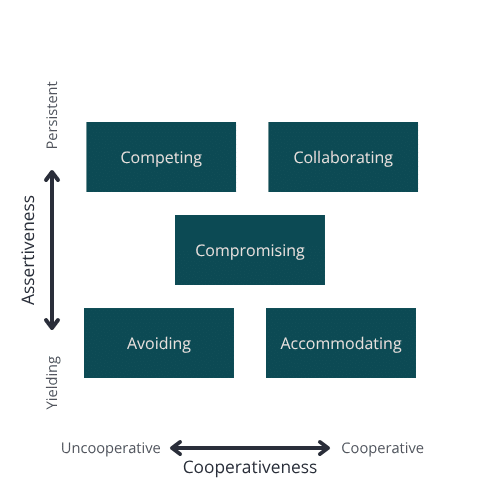
The five styles are mapped along two axes: assertiveness (yielding vs persistent) and cooperativeness (uncooperative vs cooperative):
Competing
Persistent and uncooperative. You seek to satisfy your own needs at the expense of the other person.
Collaborating
Both persistent and cooperative. You aim for a win‑win solution that satisfies both parties.
Compromising
In the middle of the spectrum. You look for an acceptable solution that partially satisfies both sides.
Avoiding
Yielding and uncooperative. You avoid the conflict without attempting to satisfy anyone’s needs.
Accommodating
Yielding but cooperative. You prioritise the other person’s needs at the expense of your own.
Source: Thomas‑Kilmann Conflict Model
Different conflicts require different approaches – and the right approach depends heavily on where in the escalation the conflict sits. The well‑known “conflict ladder” illustrates this. If the conflict is already at one of the higher steps, an avoiding or competing style will rarely lead to a constructive outcome.
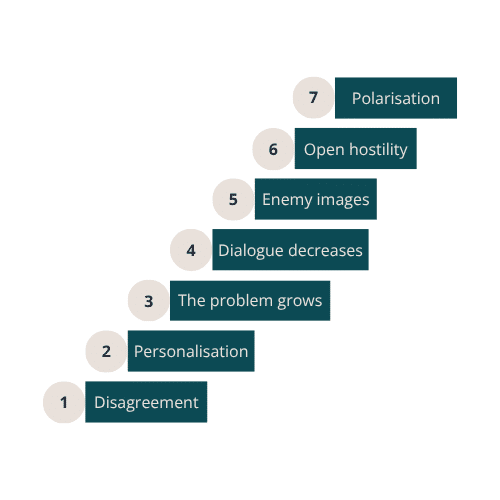
Conflict mediator Anne Buhl has expanded on the conflict ladder with the “solution ladder”, which offers practical guidance on how to work constructively with a conflict at each stage.