The art of managing risk

Risk management

Do you have a clear focus on the many risks involved when launching projects? And have you ensured that the right frameworks are in place? 

Failing to prepare for risks that ultimately materialise can prove a costly mistake.

What is risk?

A risk can be defined as an uncertain event – or series of events – which, if it occurs, will affect an organisation’s ability to achieve its objectives. The concept of risk encompasses both the likelihood of a threat occurring and the extent of its impact on business goals. It is also important to note that a risk can have either a negative or a positive effect on an objective.

When working with risk, it is useful to consider whether the risk affects the organisation’s long-, medium- or short‑term objectives, as this has a significant influence on how the risk should be managed:

Long-term, strategic risks
Risks associated with long-term strategic objectives can be difficult to identify and may only become visible far into the future. Many organisations therefore define an overarching risk policy that supports their vision, mission and values. This risk policy forms the basis for more operational risk strategies. As markets and external conditions change continuously, these strategies – and the associated risks – must be reviewed regularly.

Medium-term objectives
Medium-term objectives are often realised through projects and programmes that help develop the business. At this level, decision-making is more specific, particularly with regard to timeframes and financial constraints. Risk management therefore typically results in a clearly defined risk strategy tailored to the individual project or programme.

Short-term, operational objectives
Short-term objectives are usually linked to day-to-day operations. Decisions on risk at this level must support the achievement of both medium- and long-term goals. The risk landscape here often changes rapidly, making continuous and focused monitoring essential.

Management of risk

The term Management of risk encompasses all activities required to identify and control exposure to risks that may affect the achievement of an organisation’s business objectives (Management of Risk: Guidance for Practitioners)

How do you do it?

There are several established methods for working systematically with risk management. Regardless of the approach, the core process typically consists of four key steps: Identify – Assess – Plan – Implement.
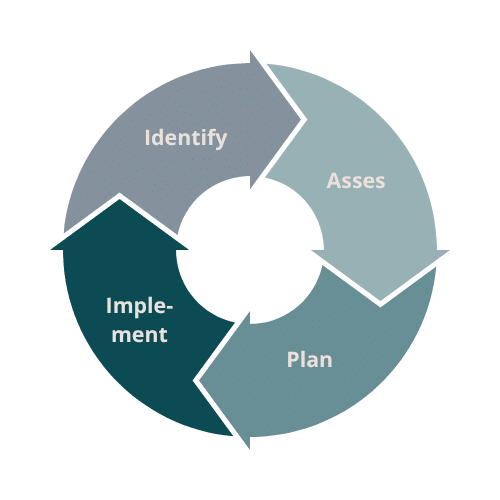
four steps in risk managementIt is no coincidence that the final step, Implement, leads directly back to Identify. Risk management is an iterative process and should be revisited continuously to ensure that risk handling across the organisation, its projects and its operations remains aligned with the current situation.

It is crucial to involve the right people in risk management activities. If the initial work is carried out within a narrow and limited forum, there is a significant risk that relevant risks will not be identified. Assessing the severity and implications of identified risks also requires perspectives from stakeholders across the organisation. It is highly unlikely that a risk, if it materialises, will affect only a single isolated area.


What can you achieve?

There are many immediate and tangible benefits to working proactively with risk management and implementing decisions that address potential threats:

  • Fewer sudden – and unwelcome – surprises
  • More efficient use of resources
  • Greater predictability in deliveries
  • Reduced time spent on “firefighting”
  • Increased confidence in budget compliance
  • Stronger internal focus on doing things the right way
  • Greater external focus on creating effective and sustainable strategies


In addition, there are more subtle but equally valuable benefits. Simply bringing risks into the open can create value in itself, as analysis and discussion encourage different perspectives on organisational objectives, context and future direction. An open and constructive approach to risk management can therefore help ensure alignment of expectations across the organisation.

Want to know more?
Harald Høi Andersen

Ready to take the next step?

Do you have a firm grip on the many risks surrounding your projects? At kaastrup|andersen, we have extensive experience in both risk management and risk mitigation, and we also work with scenario planning to ensure that organisations are well prepared to handle both external and internal influences.

Get in touch with us, and let us work together to make your projects – and your business – more robust and more profitable.

Related insights

Waiting time in projects

Stop Waiting. Start Delivering.

Project management

Where is the project manager in an agile setup?

learning and unlearning

How do we create learning and unlearning?

Conflict management

What do you do in a conflict?

info@kaastrupandersen.dk

+45 70 27 77 19