When we describe the role of the project manager, we often take our point of departure in the traditional project manager role within a waterfall model. In an agile setup, there is no role explicitly called “project manager”. However, reality shows that many of the tasks performed by a traditional project manager do not simply disappear. In agile organisations, these tasks are distributed across several other roles and carried out in different ways than in a waterfall‑driven organisation.
If we simplify the picture, we can illustrate it as follows:
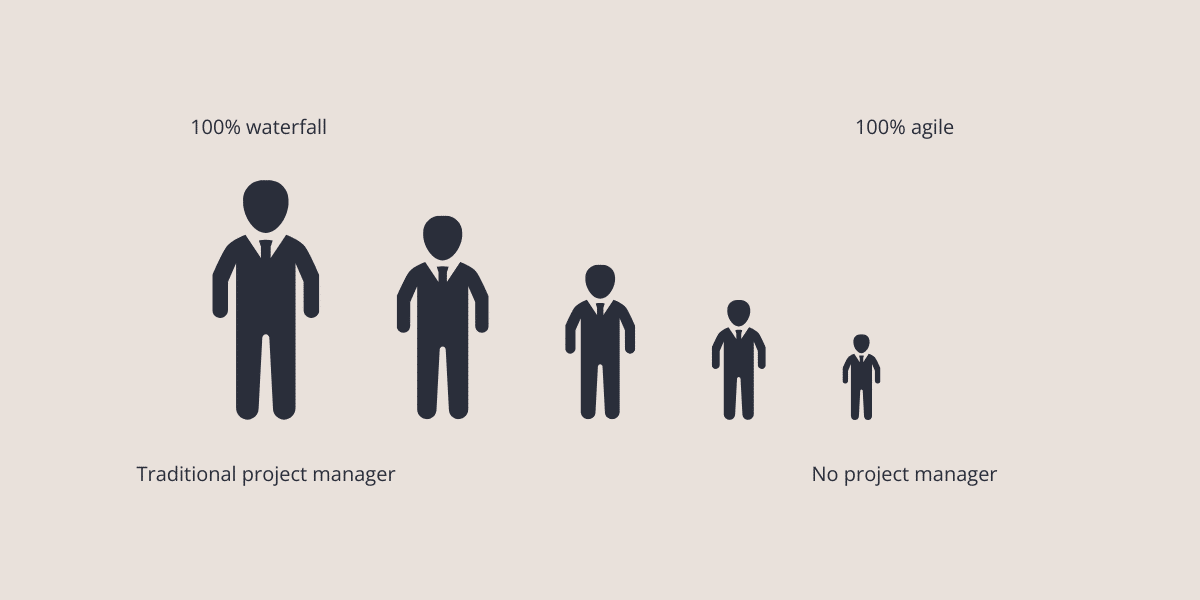
In reality, we see that the vast majority of project managers are already working in an agile way.
Theory vs. reality
From a theoretical and somewhat simplified perspective, where distinctions are sharply drawn, there are many things a traditional project manager must change in their leadership style when transitioning from waterfall methods to agile approaches.
In practice, however, we see that most project managers have already begun this transformation and operate within a mindset and value set that aligns closely with agile principles. The best project managers understand the differences and are able to balance competencies and tools from both worlds, adapting their approach to the specific project and organisational context.
The project manager role in Scrum
Scrum is one of the most widely used agile frameworks. Using Scrum as an example, we can illustrate how traditional project management tasks are typically distributed between the Scrum Master and the Product Owner.
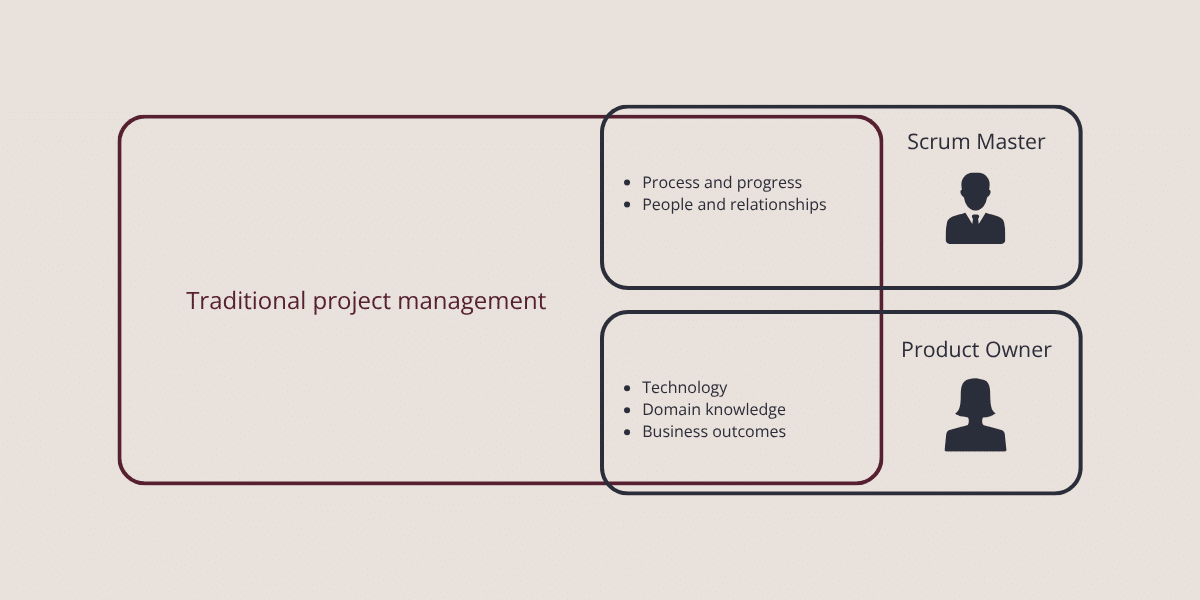
The illustration shows how responsibilities are divided in an organisation working 100% agile. However, very few organisations operate at this extreme end of the agility scale. Many are in the midst of a transformation; some aspire to full agility, while others prefer to let results determine how far they will go.
The reality is that most organisations operate in a hybrid model, combining traditional and agile methods. This means that several responsibilities are not clearly placed within the pure Scrum framework. Below is an example of a more nuanced picture of today’s reality, which can be used to clarify roles and responsibilities.
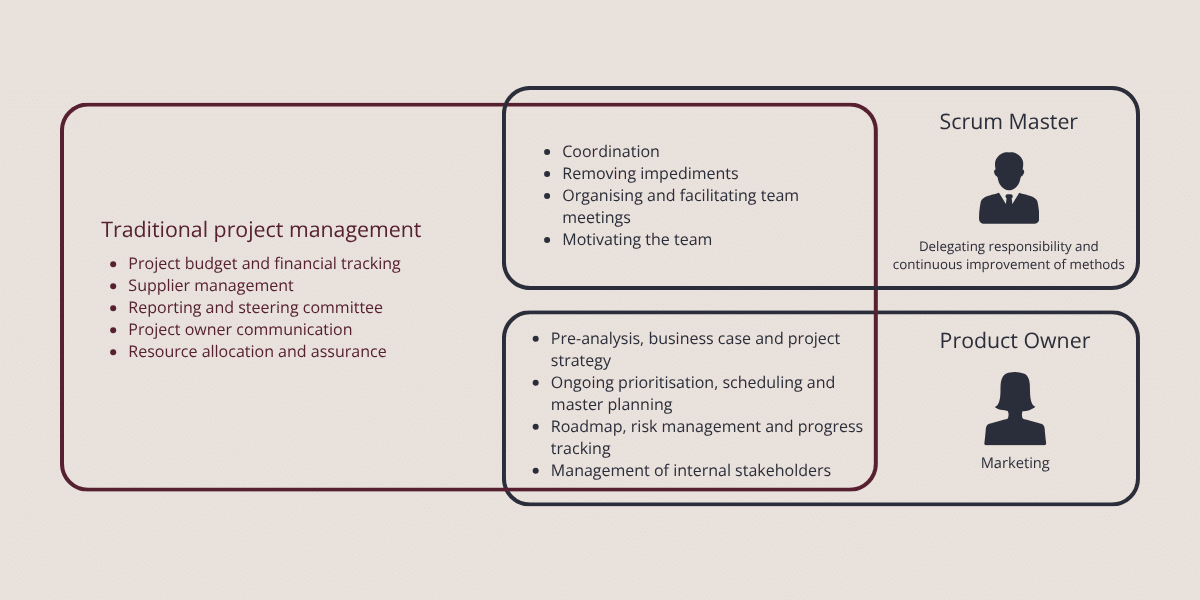
Once again, the effective project manager is the one who ensures appropriate coverage of these leadership responsibilities through dialogue and expectation alignment with the Scrum Master and Product Owner. In most cases, dialogue with the surrounding organisation is also essential. Often, stakeholders are not fully aware of what agile methods entail or how to extract maximum value from them.
The project manager must understand where the organisation currently stands and select the appropriate tools from the toolbox – both agile and traditional.
Benefits of this hybrid approach
In organisations that are not 100% agile, this approach helps identify and address all relevant leadership aspects needed to deliver projects and business value. It embraces agile principles while retaining the governance, control and reporting elements found in traditional waterfall models.
Drawbacks of this hybrid approach
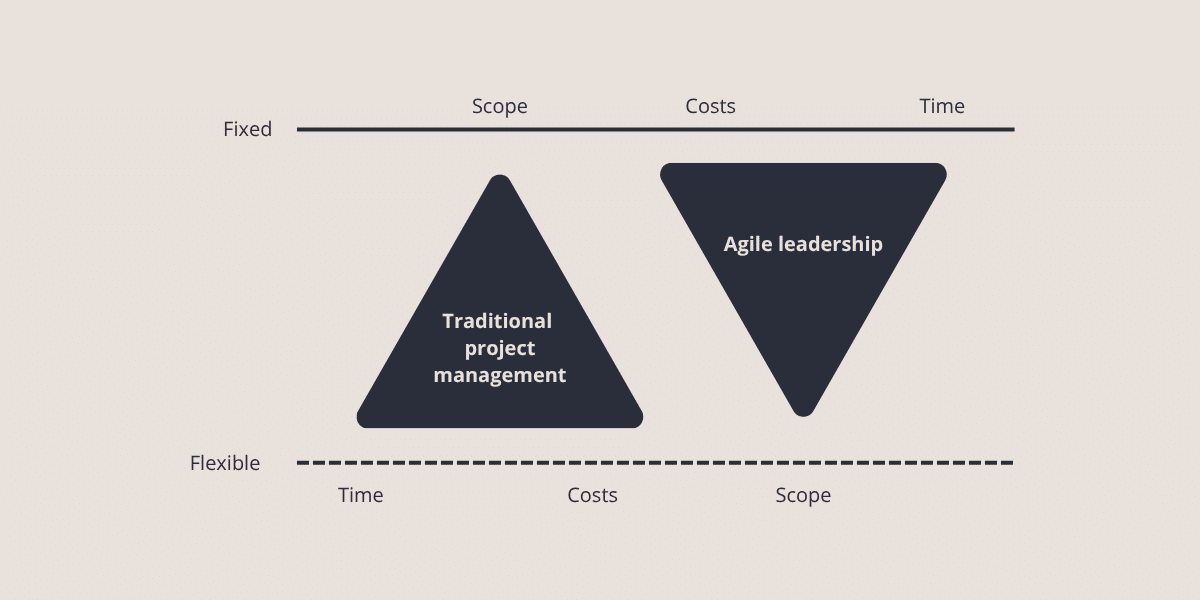
The full benefits of agile ways of working are not realised in a non‑pure agile setup. The organisation as a whole may not be designed for agility, which can create challenges. This approach requires a deep, shared understanding among all stakeholders of the rules of engagement. Furthermore, the different ways in which waterfall and agile approaches address the classic project triangle can complicate the leadership task.